
...
Max file size: Indicates the maximum size for uploading documents and pictures. Note: Upload max_filesize that is set in php.ini, see ‘System information’ and PHP info
Default Std. Document type: If a document type is selected, this will be suggested as the default when creating a new document.
...
Miscellaneous system settings


Please wait until WO/Asset etc. is saved: If this is activated, you remain in e.g. the work order screen, or you get to the work order list after saving.
...
Exhange rate: This function is only displayed when 'NOK' or 'SEK' is set as the default currency in the system. If this function is activated, the latest exchange rate is retrieved automatically from Norges Bank 's API(Norway) or Riksbanken (Sweden), and updates the exchange rates contained within the system system 15.7.11 Currency. If this is not activated, there will be a separate button inside the currency register to update the exchange rates from the API of Norges Bank (Norway) or Riksbanken (Sweden).
Profession group from responsible [WO]: The WO can be set up to inherit the profession group from the person who is set as responsible on the work order. If this is set here, the profession group can still be changed on the work order, and it will also change automatically if the responsible changes.
...
Completed = Executed date: If this is activated, the date the job was set to status 'Executed' is set as a suggested completion date when approving the job. If this is not activated, today's date is suggested as the completion date.Hour calculation locked: If
Supervisor -- > Assigned personnel [WO]: If this is activated the field From/To time displays in the function for detailed time registration '+Hours', and the work hours are locked to , the person who has been set as the supervisor on a work order will also be inserted as the assigned personnel on the job.
Electronic signature [WO/Checklists]: prevent change in the time registration. Description - -> Invoice: If this is activated, the description on the work order is included on the invoice (Service management).
Comments - - > Invoice: If this is activated, the comments on the work order are included on the invoice (Service management).
it will not be possible to approve a WO or checklist without inserting the username and password on approval.
System Language: Default system language is set here, i.e. Norwegian, Swedish, English, German or Polish. Every web user can also set their system language via ‘Edit profile’.
Reactive Maintenance: Activity group for reactive maintenance is set here. Typically this is ‘reactive’ here (corrective maintenance unplanned). This will be used in the KPI indicator on ‘My page’.
Hour calculation locked: If this is activated the field From/To time displays in the function for Invoiced Hours [on]: If this is activated, logged hours are transferred as standard to the field 'To be invoiced' in detailed time registration '+Hours'. (Service management).
Activity group ↔︎ Activity: If this is activated, only activities that are linked to the selected activity group will be selected when selecting an activity. Link between activity group and activities is made here 15.2.2 Activity.
, and the work hours are locked to prevent change in the time registration.
Description - -> Invoice: If this is activated, the description on the work order is included on the invoice (Service management).
Comments - - > Invoice: If this is activated, the comments on the work order are included on the invoice (Service management).
Invoiced Hours [on]: If this is activated, logged hours are transferred as standard to the field 'To be invoiced' in Simplified time registration: If this is activated, you see a simplified screen for posting hours in the function for detailed time registration '+Hours', in which there is no field for From/To time. . (Service management).
Activity group ↔︎ Activity: Unique asset no.: If this is activated, you must insert a unique asset number. This is not effective retroactively if it is turned on afterwards. only activities that are linked to the selected activity group will be selected when selecting an activity. Link between activity group and activities is made here 15.2.2 Activity.
Simplified time registration: Multi device: If this is activated, you see a simplified screen for posting hours in the function for detailed time registration '+Hours', in which there is no field for From/To time.
Unique asset no.: If this is activated, you must insert a unique asset number. This is not effective retroactively if it is turned on afterwards.
Multi device: If this is activated, you can be logged into the system can be logged into the system on both your mobile/tablet and desktop computer at the same time, if the user also has this activated in their user profile.
...
Items [Assets]: If this is activated, you are authorised authorized to manage assets as items, with separate item numbers, which makes it possible to connect items in/out to the asset, with associated item log. See separate description under ‘Assets’. . Also remember to activate 'Items [Object]' in the list views for work orders and history in your user profile.
Notification [Meter reading]: Validation that the registered counter count is higher than the last registered. When this is active, it will not be possible to enter a counter level lower than the previous registration.
...
Lock [Edit Purchase Order Lines]: If this is activated, the purchase order line is locked after receipt has been carried out on the order line.

System Language: Default system language is set here, i.e. Norwegian, Swedish, English, German or Polish. Every web user can also set their system language via ‘Edit profile’.
Reactive maintenance: Activity group for reactive maintenance is set here. Typically this is ‘reactive’ here (corrective maintenance unplanned). This will be used in the KPI indicator on ‘My page’.

Priority [WO]: Fixed or floating. Fixed = 1, 2 or 3. Floating = 1, 2, 3, 4, 5, etc.
Default priority: If this is set as blank, the priority on the jobs will automatically be set on the basis of the asset’s criticality, i.e. A=1, B=2, C=3 and D=3Excel format: By default set to Excel 2007 (.xlsx). Used during import/export.
Memory Limit [PHP]: By default set By default set to 128 MB. Used during import.

Do not allow negative stock: If this is activated, it will not be possible to make negative withdrawals from inventory.
Articles

Automatic parts list [AssetReduce stock [WO/Checklists]: If this is activated, by default, on approval, ‘Reduce stock’ will be checked on the approval screen. Note that this setting does not affect the automatic stock draw when approving a checklist where the unit at the lubrication point has the same unit as the article connected to the lubrication point. Here, it is deducted from the storage regardless of whether it is activated or not.
Supervisor -- > Assigned personnel [WO]: If this is activated, the person who has been set as the supervisor on a work order will also be inserted as the assigned personnel on the job.
Electronic signature [WO/Checklists]: If this is activated, it will not be possible to approve a WO or checklist without inserting the username and password on approval.
Priority [WO]: Fixed or floating. Fixed = 1, 2 or 3. Floating = 1, 2, 3, 4, 5, etc.
Default priority: If this is set as blank, the priority on the jobs will automatically be set on the basis of the asset’s criticality, i.e. A=1, B=2, C=3 and D=3.

Automatic parts list [Asset]: If this is activated, parts that are used on the work order are automatically added to the parts list of the asset, if the part is not already there.
Autogenerate article numbers: If this is activated, an article number is taken out in accordance with the selected/allocated meter under the menu point ‘System’ → 'Miscellaneous system settings’.
Structure [SELECT Storage]: If this is activated, the storage structure is displayed in the selections where stock is selected. For example. under ‘Articles’. Activate, for better viewing, if you have a deep storage structure.
...
parts that are used on the work order are automatically added to the parts list of the asset, if the part is not already there.
Autogenerate article numbers: If this is activated, an article number is taken out in accordance with the selected/allocated meter under the menu point ‘System’ → 'Miscellaneous system settings’.
Structure [SELECT Storage]: If this is activated, the storage structure is displayed in the selections where stock is selected. For example. under ‘Articles’. Activate, for better viewing, if you have a deep storage structure.
Additional costs [Materials]: Various articles (Additional costs). Used in connection with invoicing jobs (Service Management) and in connection with the invoicing of rented equipment (the lending/renting functionality).
Additional costs [Work]: Various articles hours/work. Used in connection with invoicing jobs (Service Management).
CostCarriers [Invoice/Hours]: Retrieving carriers on invoice lines and department on time registrations.
0 = Department from WO, Account from WO, Carrier from WO and Objective from WO.
1 = Department from employee, account from WO, Carrier from WO and objective from WO.
2 = Department from employee, account from Inventory, Carrier from WO and objective from WO.
3 = Department from employee, account from Accounting (Appendix set-up), Carrier from WO and Objective from WO.
4 = Department from WO, Account from Inventory, Carrier from WO and Objective from WO.
CostCarriers [Asset --> WO]: Cost carriers that are set up on an asset are inherited on work orders and history in accordance with whatever has been checked/activated in Department, Account, Carrier and Objective.
Reduce stock [WO/Checklists]: If this is activated, by default, on approval, ‘Reduce stock’ will be checked on the approval screen. Note that this setting does not affect the automatic stock draw when approving a checklist where the unit at the lubrication point has the same unit as the article connected to the lubrication point. Here, it is deducted from the storage regardless of whether it is activated or not.
Reduce stock [History]: If this is activated, ‘Reduce stock’ will be checked by default in the screen for selecting items on the history job.
Articles [For approval]: The system can be set up to require approval of new registered articles before they are put into use. Access to approval of new articles is set on the employee's user profile 17.0 Edit profile.
WO → Invoice [History]: If this is activated, invoices can be created for historical jobs (Service management).
Articles [VISMA]: If this is activated, only these two articles are used ('Add. cost [Materials]' and 'Add. cost [Work]') in VISMA for materials and work.
Default unit: By default is set to pcs and whatever is used on articles. Can be overridden within the article.
Reservation of articles: This is where you set the number of weeks ahead that articles/parts that are planned for work orders should be reserved.
Transaction Cost: This is where you set which parts cost should be used on withdrawal transactions against work orders. 0 = uses the parts cost that is set for the part on the work order. 1 = uses the cost price that is set for the article in the article register. 2 = uses the cost price that is set for the article in the article register, and also updates this price on the work order.
Location treatment: This is where the default location treatment of the inventory directory is set (can be overridden within the individual inventory directory). Fixed - the article can only be placed in one location in the same inventory. Floating - the article can be placed in several locations in the same inventory. Note: only the default inventory directory is shown in the article list. Last = will always use the last location used, and here the article can also be placed in several locations in the same inventory.
Purchasing

...
Default unit: By default is set to pcs and whatever is used on articles. Can be overridden within the article.
Reservation of articles: This is where you set the number of weeks ahead that articles/parts that are planned for work orders should be reserved.
Transaction Cost: This is where you set which parts cost should be used on withdrawal transactions against work orders. 0 = uses the parts cost that is set for the part on the work order. 1 = uses the cost price that is set for the article in the article register. 2 = uses the cost price that is set for the article in the article register, and also updates this price on the work order.
Location treatment: This is where the default location treatment of the inventory directory is set (can be overridden within the individual inventory directory). Fixed - the article can only be placed in one location in the same inventory. Floating - the article can be placed in several locations in the same inventory. Note: only the default inventory directory is shown in the article list. Last = will always use the last location used, and here the article can also be placed in several locations in the same inventory.

Additional costs [Materials]: Various articles (Additional costs). Used in connection with invoicing jobs (Service Management) and in connection with the invoicing of rented equipment (the lending/renting functionality).
Additional costs [Work]: Various articles hours/work. Used in connection with invoicing jobs (Service Management).
WO → Invoice [History]: If this is activated, invoices can be created for historical jobs (Service management).
CostCarriers [Invoice/Hours]: Retrieving carriers on invoice lines and department on time registrations.
0 = Department from WO, Account from WO, Carrier from WO and Objective from WO.
1 = Department from employee, account from WO, Carrier from WO and objective from WO.
2 = Department from employee, account from Inventory, Carrier from WO and objective from WO.
3 = Department from employee, account from Accounting (Appendix set-up), Carrier from WO and Objective from WO.
4 = Department from WO, Account from Inventory, Carrier from WO and Objective from WO.
CostCarriers [Asset --> WO]: Cost carriers that are set up on an asset are inherited on work orders and history in accordance with whatever has been checked/activated in Department, Account, Carrier and Objective.

Invoice [Purchasing]: Default invoice address is taken from this addressee in the purchase order.
...
Email [PO Approved]: If an email address is inserted here, this address will receive an email notification (incl. purchase order attached as pdf) when a purchase order has been set to approved.
Reception [Confirmed]: If you want goods receipts to only be made on confirmed order lines, this can be set up her.

Refresh/update Cost Price [Articles]: This is where you set how the cost price of the article will be updated when goods receipt is performed. Among other things, the cost price forms the basis for calculating the inventory value.
None = no update of applicable cost price
Previous = the cost price is updated with the previous price
Average = an average calculation is performed of that which is in the inventory and that which is coming into the inventory.
Period [Work Orders]

Window of Time [WO]: Work orders are hidden forward in time here.
...
See also ‘Time window [Work order]’ in ‘Edit profile’ 17.0 Edit profile .
Due Status

Due Status WO:
Week = light bulb changes from green to yellow on the Monday in the week of From Date, and light bulb changes from yellow to red on the Monday in the week after To Date.
Date = light bulb changes on date.
...
Date = light bulb changes on From/To Date.
Checkpoint status = light bulb on checklist head is controlled by the due status light bulbs on the checkpoints. For example, if there are red checkpoints on the checklist, the light bulb status on the checklist head will also be red. .
Approve Word Orders - [Next occurance] [Default]


Copy parts to new WO: if this is activated, it will be set by default on the job upon approval, and the parts will be included in the next occurrence of the recurring job. The checkmark can be removed within the job while approving.
...
Copy comments to new WO: If this is activated, it will be set by default on the job upon approval, and the comments will be included in the next occurrence of the recurring job. The checkmark can be removed within the job while approving.
Status: This is where you set the default workflow status of the new recurring job that is created on approval.
...
Include - from the job that is being approved over to a new job.
New [Work description] – use the description that is in the connected work description.
VISMA Integration

Setup regarding invoice status (Saved or Executed) that the invoice should have in the system before transfer to Visma. You can have different setups when creating invoices from WO and from Rental.
R2 Integration

Setup for integration with the R2 booking system.
Accounting [Appendix]
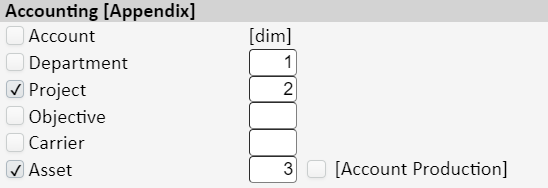
To be used when generating bundle files 9.9.0 Bundle [List view] . Only those that are activated will join the bundle with dimension (order) that is set here. If [Account Production] is activated, this account, which is an account on the asset, will override (if there is an account on the asset) the account in the accounting settings for the article group.
Note also that if 'Department' is activated, a requirement is set to fill in the department for input, withdrawal and adjustment transactions, regardless of whether accounting settings 15.5.6 Accounting are set up or not. For withdrawal transactions via WO/history, it is assumed that a department exists at the WO/history job.
Maps

OpenStreetMaps is integrated, and this is the default unless another option is selected here. Google Maps may result in a licence being required by Google if it is used frequently. We therefore recommend not activating this. For more information, contact our Support department.
Colors/Themes


Setup for setting colours colors and themes in the system. In addition, every user can select/set colourcolor/theme themes in their user profile.
Background color: Activate this if you want to have the original color of mandatory fields, i.e. no red frame around the fields.
License API

For use by Ørn Software AS.
KPI

This is where the performance activators that are shown on ‘My page’ are activated/selected. For further details about these, see the description here: 19.1.0 My Page.
Help
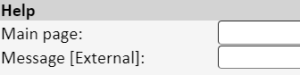
Main page: Here you can insert a link to a web address or other info that will be reached via the menu point ‘Help’.
Message [External]: In the same way as above, you can insert a link or other info that will be reached via the menu point ‘Help’ in the external registration form.
Bulletin

Field for inserting a specific bulletin that is displayed in the system when it is locked (checkbox to the right).
Logo

Via ‘Choose File’, you can upload your own company logo. The logo will display in the system and on all default PDF printouts.